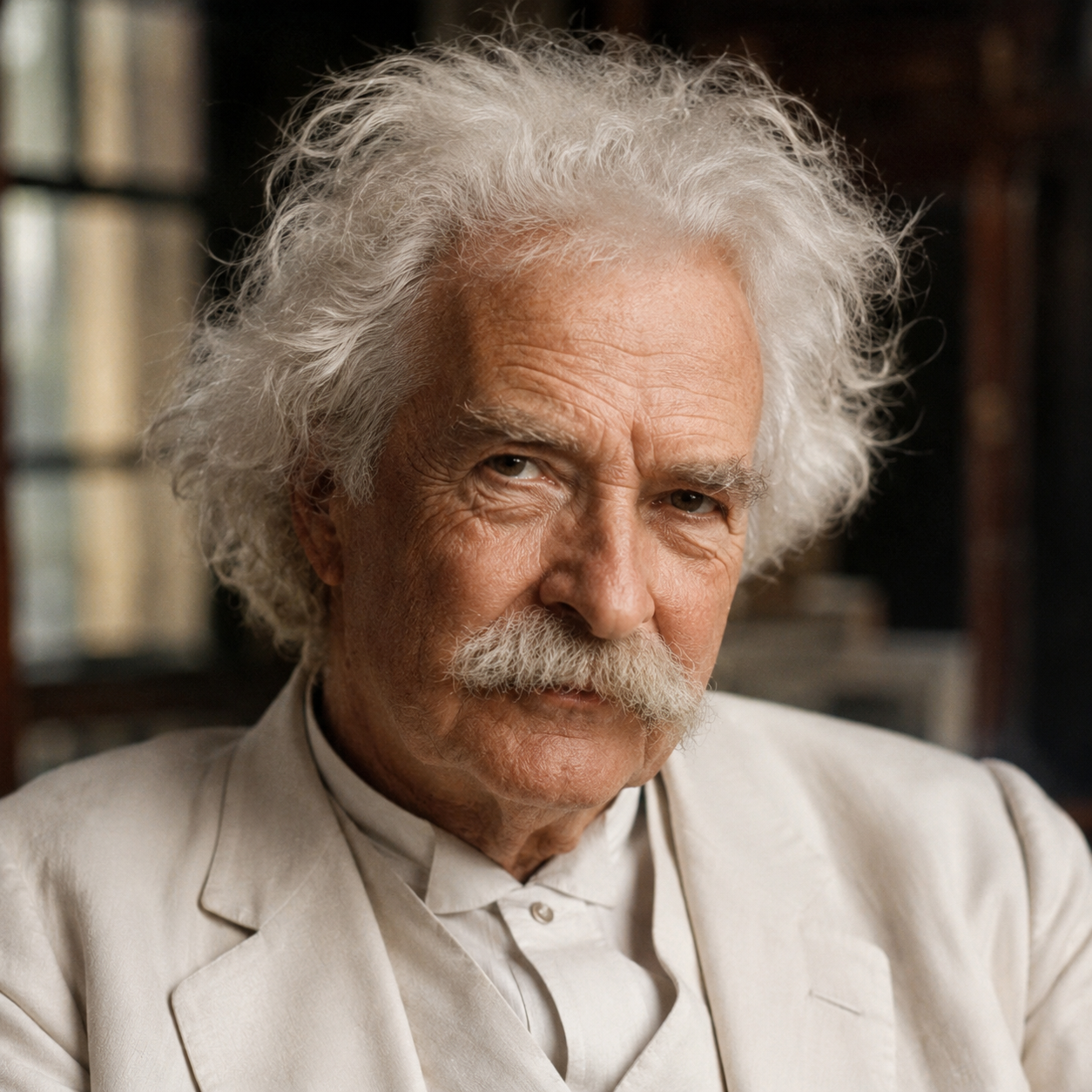
Physicist · Philosopher · 1879–1955
Born Ulm, Germany · Nobel Prize 1921 · Princeton, New Jersey
"Imagination is more important than knowledge."
He redrew the map of reality. Relativity, the photoelectric effect, Brownian motion — all in a single year, working as a patent clerk in Bern. Talk to the man behind the myth: warm, funny, deeply human, and still capable of stopping you cold with a single thought.
How It Works
First 3 minutes free. Minutes 4 through 6 cost $2.99 total. After that, just $1.00 per minute.
🐾 Every paid call triggers at minimum a meal donation for a rescue dog
Albert Einstein · c. 1947
The most beautiful thing we can experience is the mysterious. It is the source of all true art and science.
— Albert Einstein, What I Believe, 1930
What to Ask
"Was there a moment you knew relativity was right — before any proof?"
He'll describe the thought experiment on the light beam. You'll feel the click of it.
"What do you actually think about God?"
Not the bumper sticker answer. The real one — Spinoza, the cosmos, what mystery means to a scientist.
"Do you regret the letter to Roosevelt?"
The letter that started the Manhattan Project. He signed it. He'll tell you why — and what it cost him.
"Why did your first marriage fail?"
Mileva Marić was also a physicist. The story is more complicated than history usually tells it.
"What do you make of quantum mechanics?"
"God does not play dice." Bohr disagreed. This argument is still unresolved. Hear his side.
"Are you happy?"
An unexpected question for an unexpected answer. The most famous mind of the century, asked the simplest thing.
Albert Einstein did not speak until he was three years old. His teachers found him slow. One called him "mentally slow, unsociable, and adrift forever in his foolish dreams." In 1905 — working as a third-class patent clerk in Bern, Switzerland — he published four papers that rewrote physics. Any one of them would have made a career. Together, they changed everything.
He did not arrive at his discoveries through calculation alone. His method was imagination. He called them thought experiments. He imagined riding alongside a beam of light. He imagined an elevator falling in free space. The mathematics came after — to confirm what intuition had already told him was true.
Einstein was also a deeply political man. He fled Nazi Germany in 1933 and never returned. He was a pacifist who nonetheless signed the letter urging Roosevelt to develop the atomic bomb — a decision that haunted his final years. He was offered the presidency of Israel and declined. The FBI kept a file on him for decades.
He played the violin. He loved sailing, even though he couldn't swim and refused to learn. He was married twice, had complicated relationships with his sons, and was devoted to his sister Maja until her death. He died in Princeton in 1955, having refused surgery, saying: "I want to go when I want. It is tasteless to prolong life artificially."
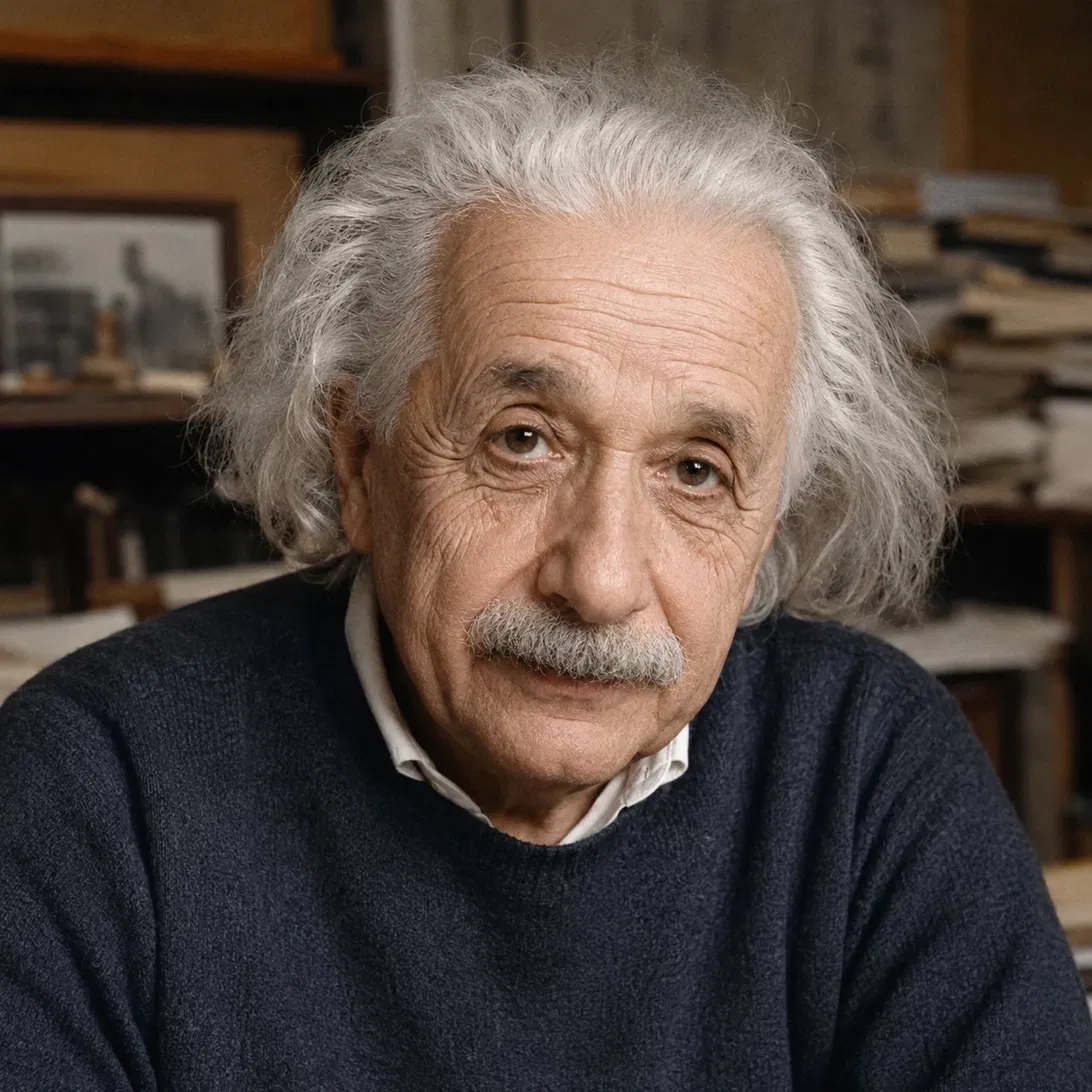
No script. No recordings. A live AI voice trained on Einstein's letters, lectures, and interviews — speaking only to you, only now.
Start Your Free Call →🐾 Every paid call triggers at minimum a meal donation for a rescue dog